• The first thing I did this morning, after thanking the weather spirits for preserving our electric power, was to take a few ice pictures. Full disclosure: I Photoshopped this first image severely. Couldn’t resist.

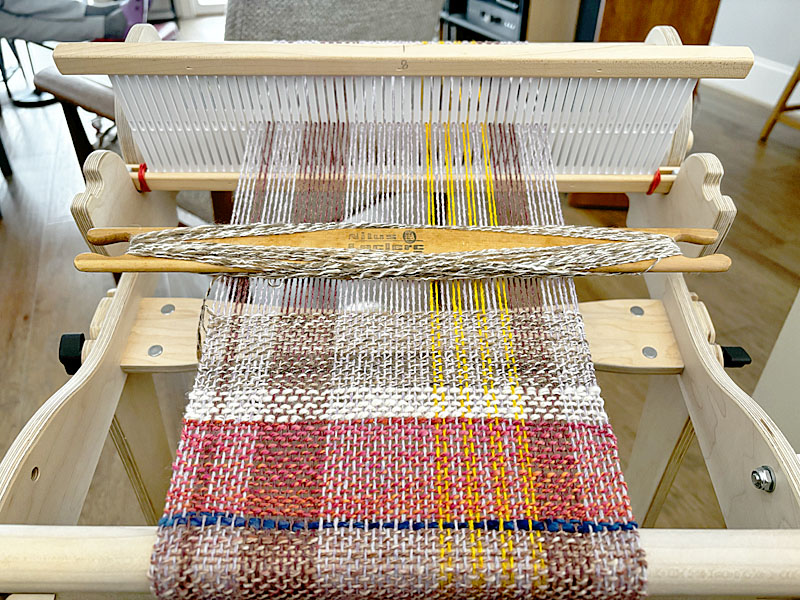
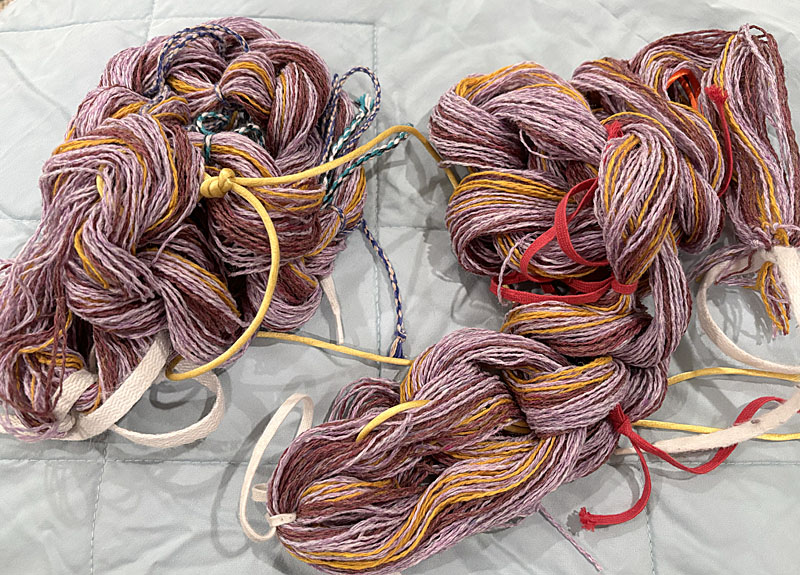
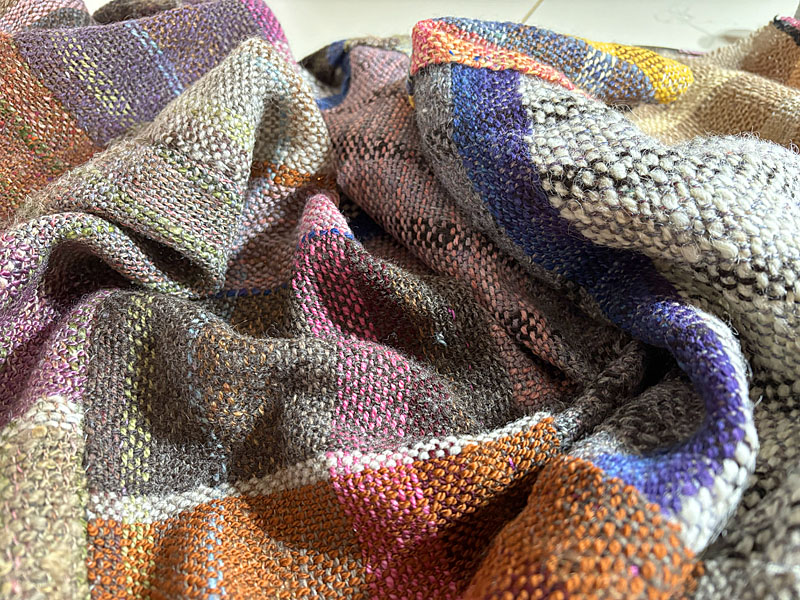
    Back indoors I went to work on the two small warps I wound yesterday for the rigid heddle loom. These will be to add width to the strip-woven blanket. I used some Harrisville shetland for these, although the rest of the blanket is 100% handspun. I think it will be a good combination. of materials.

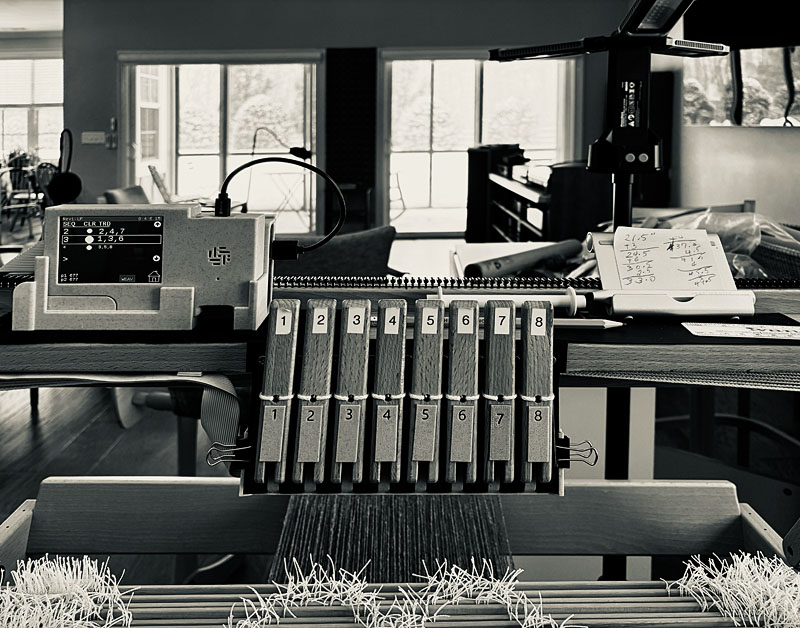
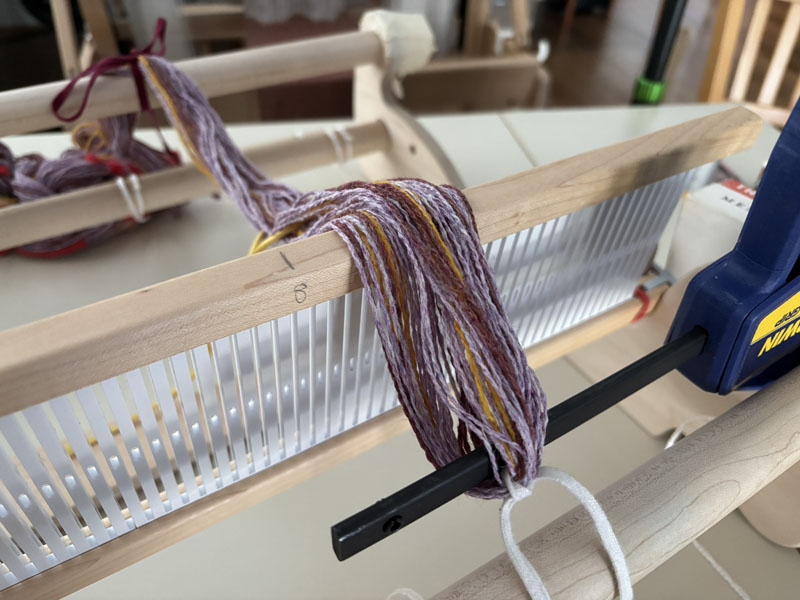
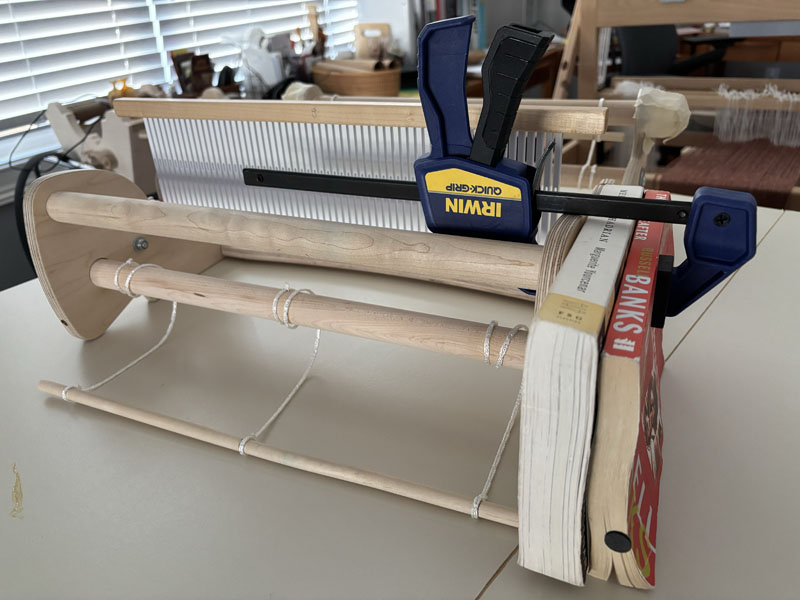
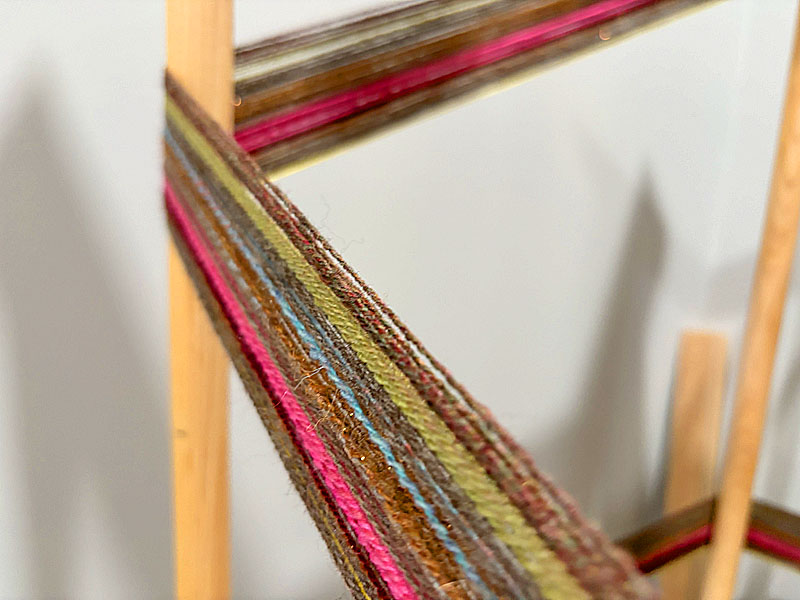
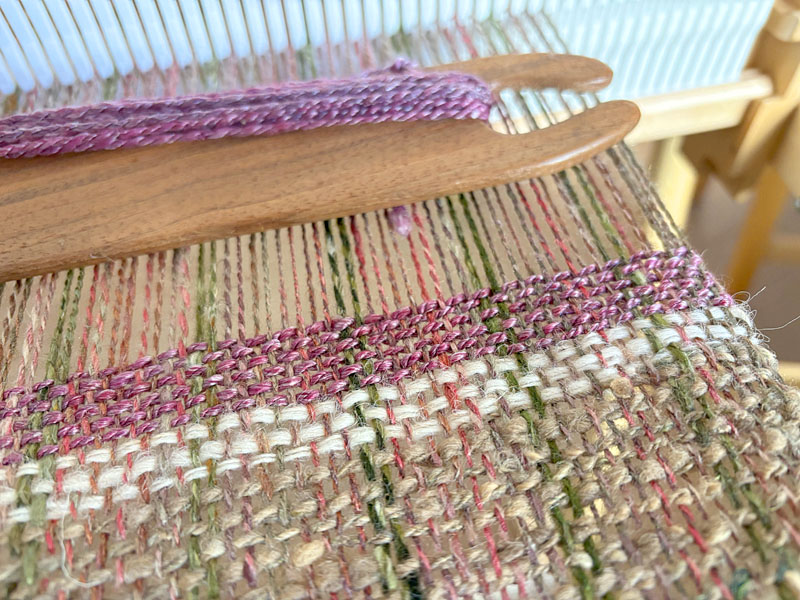
    Here’s a little invention I’m working on for my Cricket loom. I really like to wind warps on a warping mill, and forego direct warping on rigid heddle looms, because I find it more pleasurable to design striped warps that way. But I really need something to catch the end loops of each pair of warps, without having to fuss with the cords that secure the warp rod to the warp beam. The metal bar on my quick-grip c-clamps fill the bill. I catch the first half of the warps on the bar in the following position.

    The paperbacks in the following photo temporarily hold the bar in position, then I remove the paperbacks for loading the second half of the warp

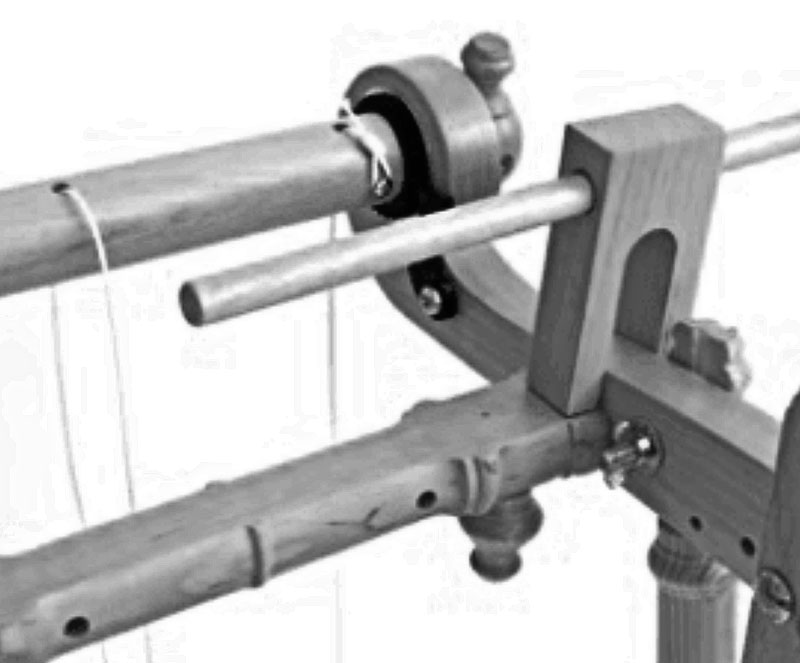
    Then I transfer all the loops to the warp stick, attaching the polyester cords to the stick as I go. I wish someone with a 3D printer would design some clamps to do all this more easily, similar to this system on the Kromski Harp, my other favorite RH loom:

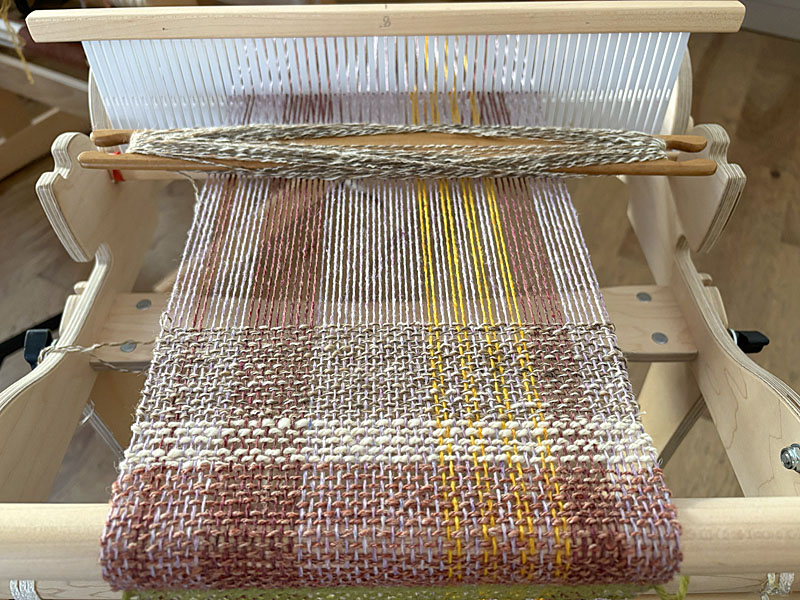
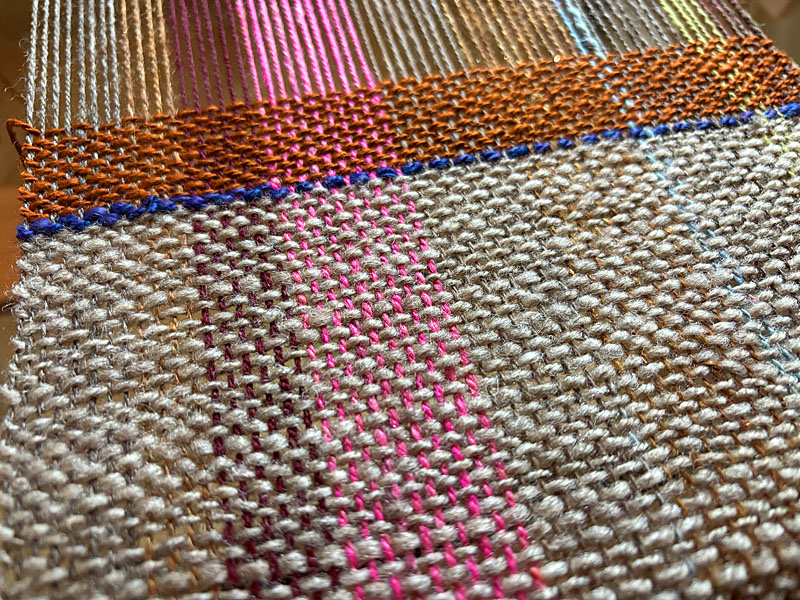
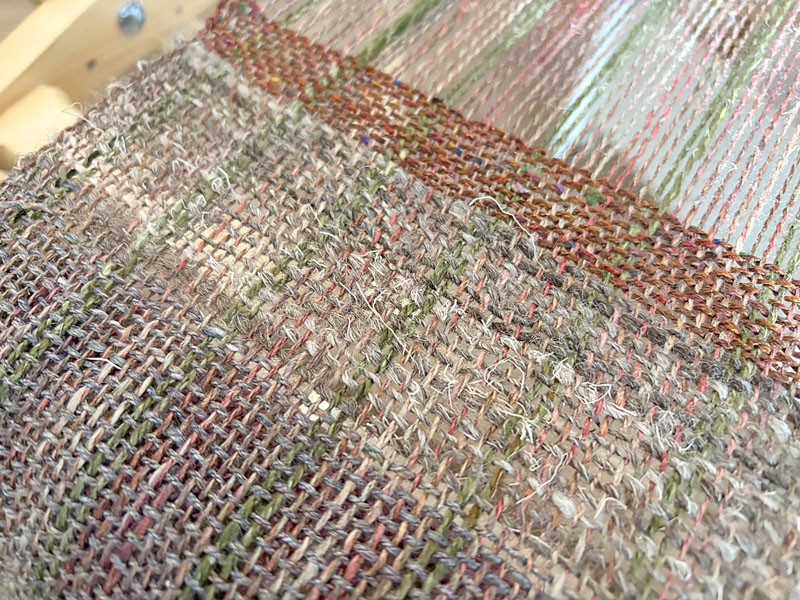
    Be that as it may, the warping went very quickly and here is the strip in process of being woven, with handspun wool and wool blends as weft.

    While all this busy-ness was happening in the front of the house, my Christmas cactus by the back window was quietly pursuing her annual blooming cycle. For some reason, she only puts out a couple of blossoms a year, but each one is a gem.

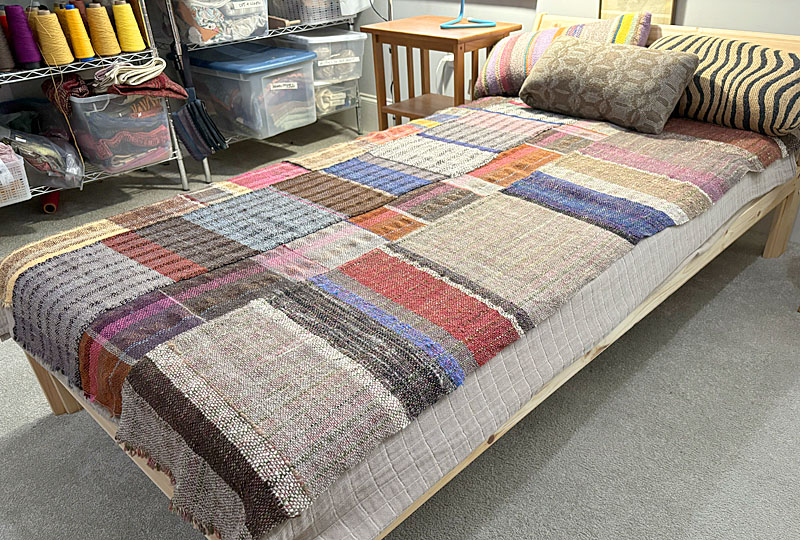
  • The last few days have been devoted to sewing the final section of blanket to its companion strips.

    The blanket looks pretty good on the bed, but it’s not quite wide enough yet. I think two more strips, one along each side, will be just about right.

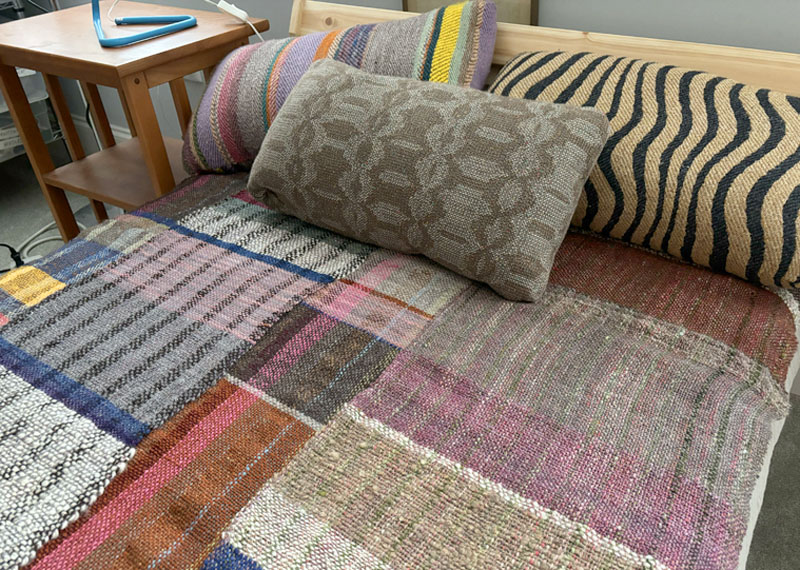
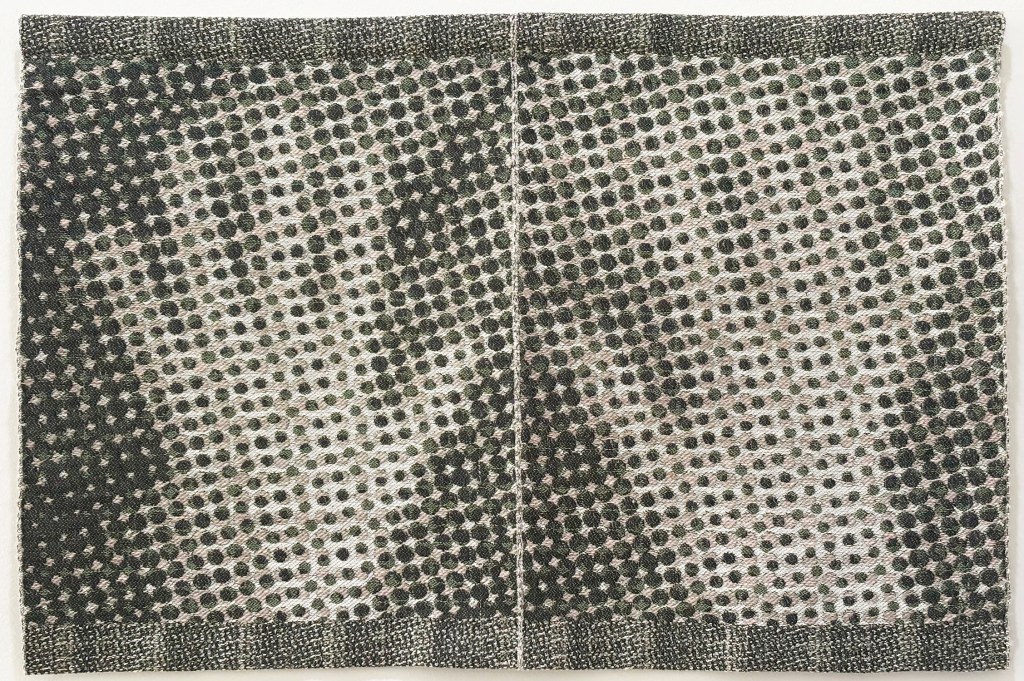
    The pillow on the right is doublewoven jacquard from many years ago, in silk noil and wool. The gray one in front is also silk noil, dobby woven, 16 shafts. The stripey one is weft-faced twill, with odds & ends of handspun wool on a linen warp.

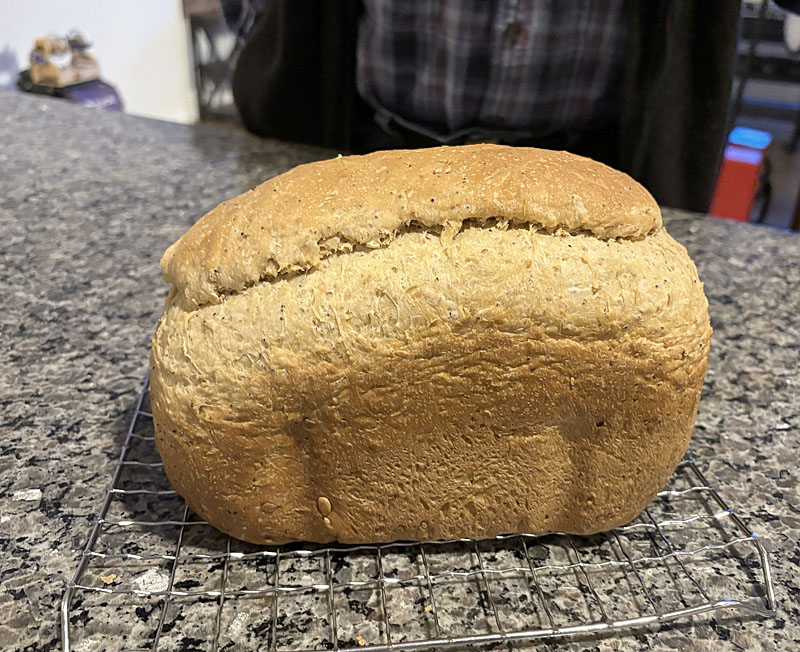
    And before the ice storm arrives , and while we still have electricity, I baked a loaf of bread. It’s fairly level, not the dreaded ski slope loaf.

    Bundle up, everybody. I’ll talk to you on the other side.

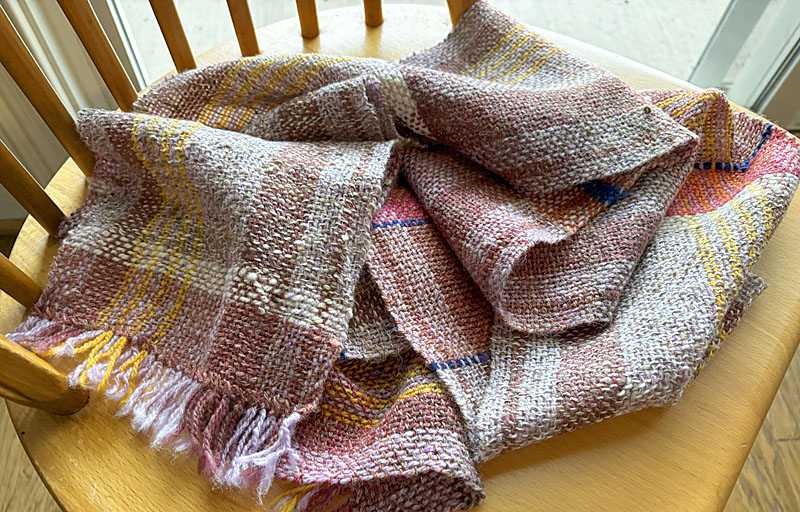
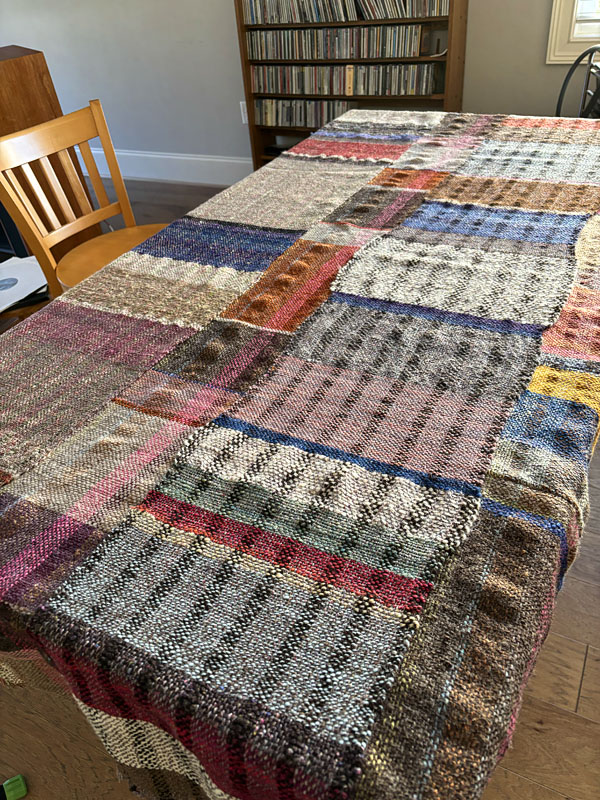
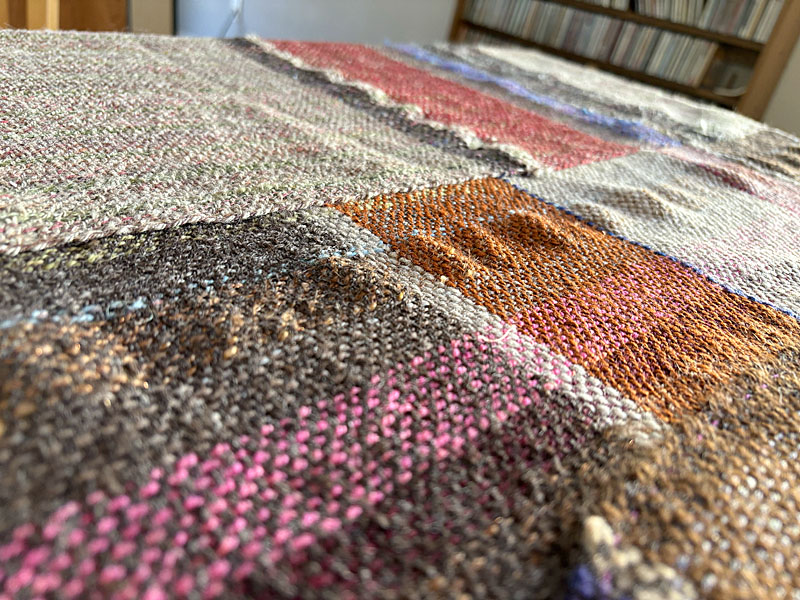
  • I’ve been accumulating a collection of 3-yard strips woven on a rigid heddle loom. The yarns are all handspun wool and wool blends, plied, from a stash that goes back over 50 years. Spinners will recognize that wool yarns have widely differing takeup and shrinkage properties depending on breed of the sheep, amount of twist, yarn size, etc. Well, here’s a perfect demostration, laid out on my worktable.

    The warp has seersucker-type ripples, and the selvedges meander in fantastic curves. I don’t mind the warp ripples. I rather like them. But the curving selvedges are another matter. Do I just ignore them and hide them in the seams, or, as I have done here, embrace them?

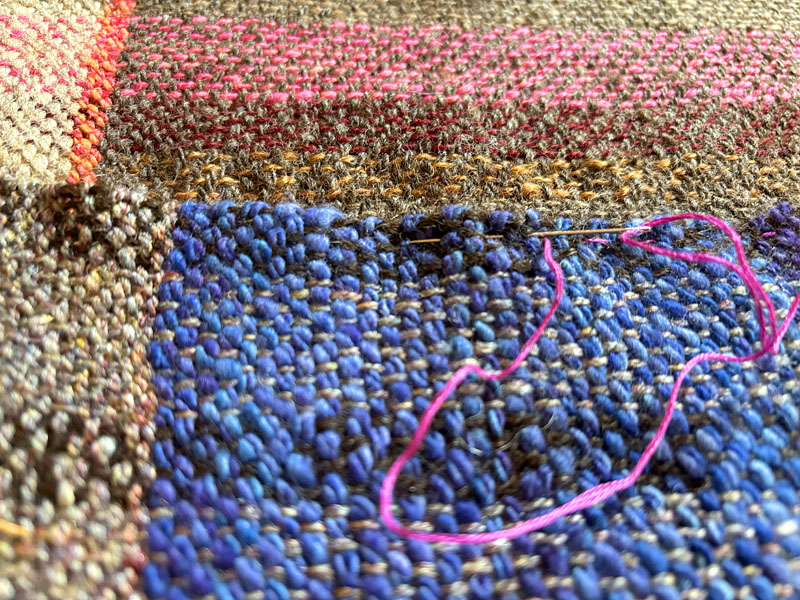
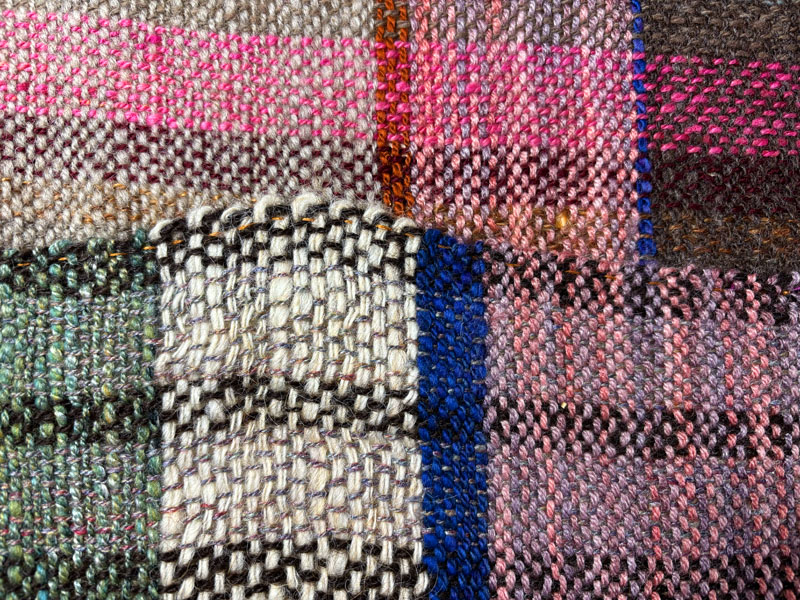
    I have chosen the latter. I lap the selvedges and handstitch them with embroidery floss, in a running stitch. I let the selvedges meander as they will.

    This blanket is headed for the bed in the spare room. The future occupants may or may not enjoy the meandering selvedges. I’ll let you know.

    Department of Books: I just finished reading Worn by Sofi Thanhauser. Highly recommended for weavers, other yarnies, and for all other people who wear clothes.

  • There are many versions of the children’s folk song “Here we go loopty loop”–you may have learned “looby loo” or other variations — but I especially like the last line of the refrain, which goes “all on a Saturday night.”

    On a recent Saturday Night I loopty looped this 8″ wide warp as a stashbusting exercise and…

    …the next day I beamed and threaded it on a rigid heddle loom. Put your right hand in, put your right hand out. Now it’s nearly all woven. More than likely I’ll get it cut off today and wash it. It will then join its sister warps in a multi-strip project which may or not become a blanket or a poncho. Or something else.

    This new style of making is pleasant. I love working with the handspun wool and waiting to see where it leads me.

    Department of Books: Have just read American Woman by Susan Choi. Recommended.

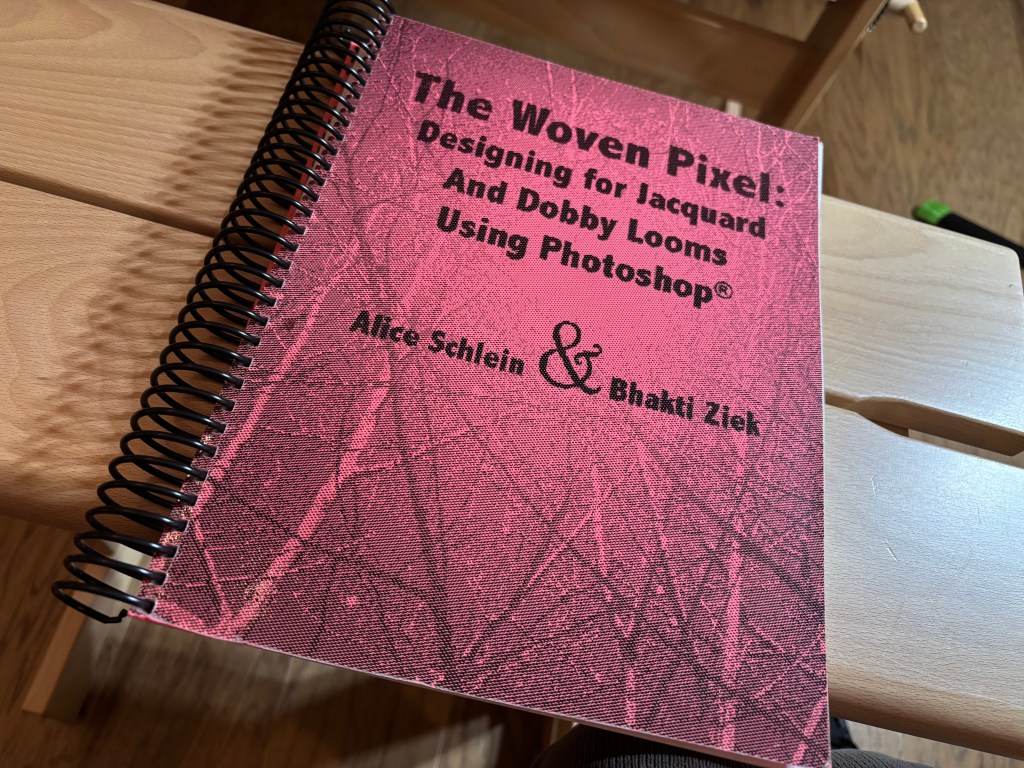
  • It’s been 20 years since the publication of The Woven Pixel: Designing for Jacquard And Dobby Looms Using Photoshop® (see sidebar). Bhakti Ziek and I, at opposite sides of the country, thought it was important to document our individual explorations in digital weaving and make our joint efforts available to the weaving community. We worked remotely, emailing chapters back and forth to each other for revision and editing. We taught ourselves Adobe Indesign and did our own layouts. It was intense work and pretty much took over our lives for more than a year.

    And now we’re very happy to announce that The San Jose Museum of Quilts and Textiles is mounting an exhibition honoring our work on January 29 through May 11, 2026. To quote the museum newsletter, “This exhibition explores the rise of digital weaving which emerged in the early 2000’s. It brings together a variety of work by artists and designers who experiment with digital looms and jacquard software. It pays tribute to two artists in particular, Bhakti Ziek and Alice Schlein, who wrote The Woven Pixel (2006), which quickly became something of a bible for weavers in art, design and industry–and referenced still today.”

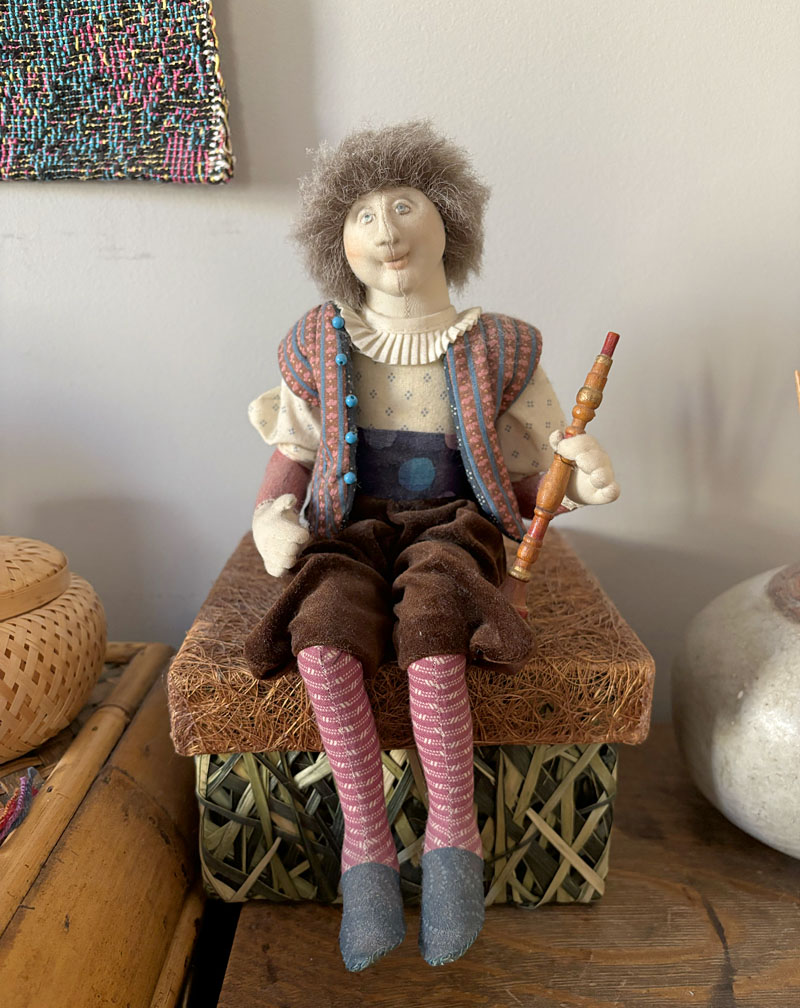
  • I chose a photo of this little musician (about 10″ tall when seated) to convey my New Year’s greetings to you. He’s a cloth doll handcrafted by the late, great dollmaker Akira Blount and has sat on my desk for many years. He smiles enigmatically as he prepares to play his recorder for us.

    He sports brown velveteen pants, rose striped stockings, a gaily patterned vest with blue buttons, a pleated collar, and a long, pointy cap with a bell on the end. His wee expressive fingers are carefully delineated and stuffed.

    In the Department of Books…I have just finished reading The Far Field by Madhury Vijay. Recommended.

  • On my walk yesterday morning I passed a construction site and saw this very amusing dumpster. I did not mess with the image at all, except to crop it a little. It kept me laughing for the rest of the day.

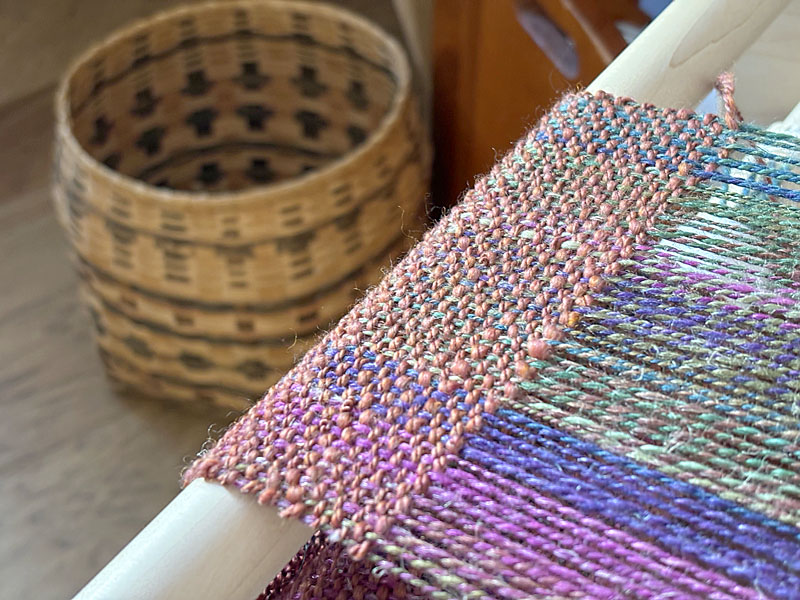
    Back in the studio I worked at my current RH project and was thinking mostly about handspun yarn, and totally missed the beautiful out-of-focus Cherokee basket in the background. This basket has kept me excellent company for over 40 years. I wish to acknowledge the artisan who created it. Wherever they are now.

    In watercolor class my instructor used to tell me that a diagonal element would add more energy to an image. Now, to celebrate the winter solstice, here’s a picture about diagonals. I hope these diagonals are pointing up, not down. I hope this is good energy. I hope the days will get longer. I hope we will all behave as better humans.

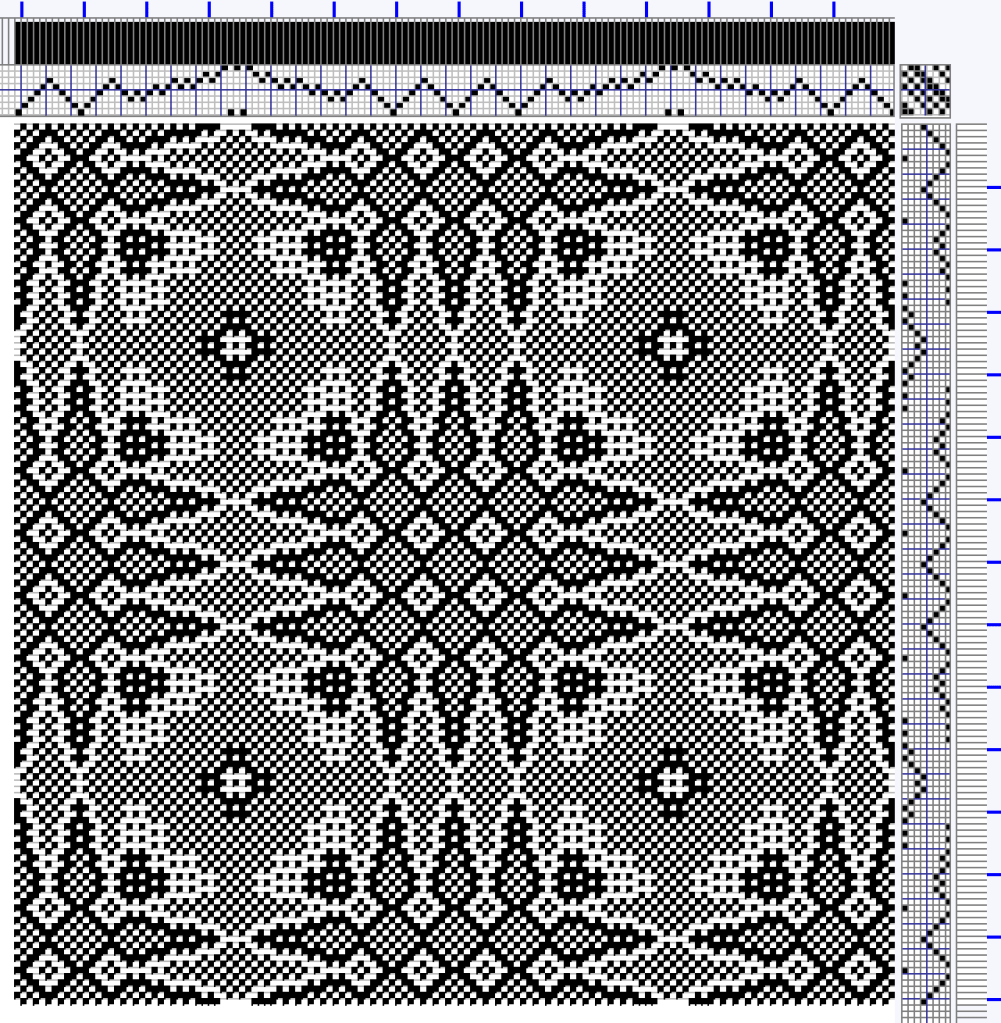
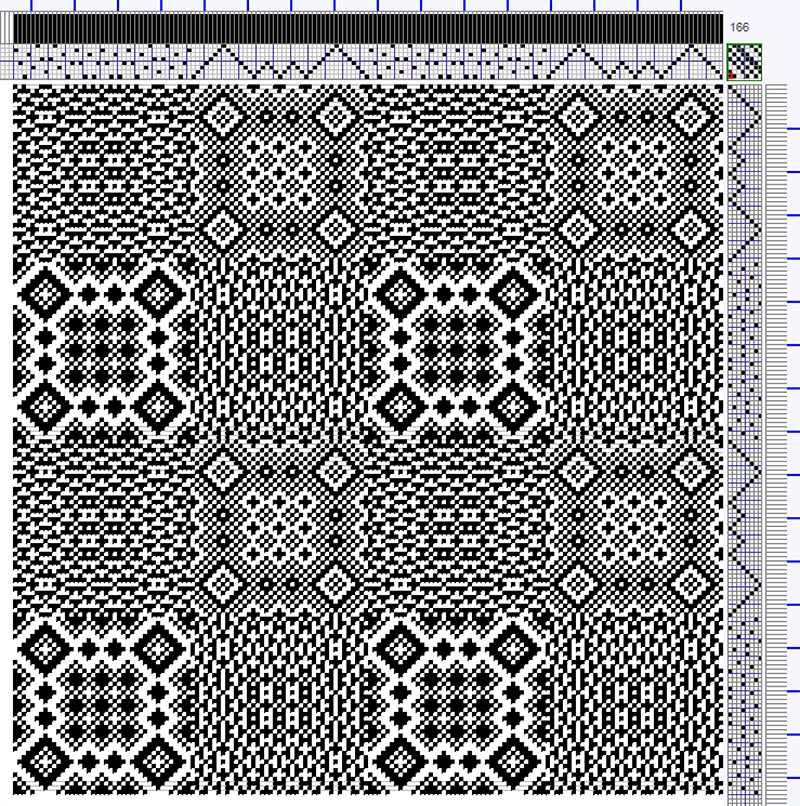
  • Yes, truly, that’s what I have entitled this draft. I doodle on the computer when the yarn refuses to behave. Or when the weaving pixies run amok, as they have this week.

    It’s an amalgamation on a simple point twill, no networking here, and I designed it with the help of TempoWeave on my Mac. See sidebar for more resources about amalgamation.

    If you look at the amalgamated (i.e., fuzzy) parts of this draft and squint a little, you will see some lacy bits. That’s where the longer floats tend to gather. But no floats are longer than 5 in this draft. Feel free to use it in your own work, but please give appropriate credit. If you’d really like to see a wif, just leave me a comment. If enough people are interested, I’ll upload it to handweaving.net.
    You can have so much fun with these simple amalgamations. Flip, wrap, or rotate the tieups, Add color, or go for total monochrome and just concentrate on the textures.

    And here’s a bit of hope for all my friends, a sunrise picture captured o a cold morning. Happy holidays, everyone,

  • Sometimes it’s simple, like what to have for dinner. Other times, it’s more serious. But mostly, we just enjoy hanging out together.

    Occasionally I have conversations with my yarn. I find wool yarn is the most forgiving, Too tight? Too loose? Wool doesn’t care. Skipped a dent? No biggie. Here I am working on a rigid heddle project with my handspun wool yarn. It has been undone and redone so many times. Wool just looks the other way,

    Department of Books. I have recently read Book and Dagger by Elyse Graham; Flashlight by Susan Choi; and A Wild Sheep Chase & Dance Dance Dance by Haruki Murakami.

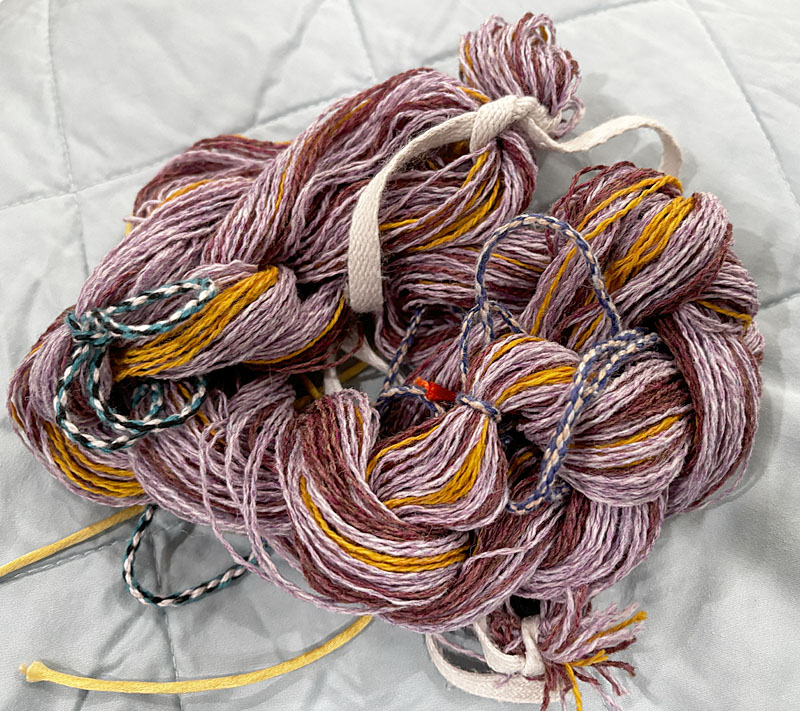
  • What do you do when your hands aren’t working the way they used to, and you have to give them a rest from throwing shuttles? Hereabouts the solution is to make a deep dive into the stash of handspun wool and warp up a rigid heddle loom.

    The longish skeins of habdspun are used for warp, and the shorter bits are perfect for weft stripes, hit-or-miss. This project will turn up in a garment. If I’m lucky it will be done soon, as the weather has turned cold here.
    I’m taking a risk, because some of the yarns are softest merino and some are hairy longwools, so after washing I’m expecting a few wavy spots, but nothing that can’t be fixed with a few blasts from my steam iron. Living dangerously!

    Meanwhile, in the Department of Books, I’ve just finished reading Vol. 1 of Rick Atkinson’s new trilogy, The British Are Coming: The War for America, Lexington to Princeton, 1775-1777 (The Revolution Trilogy Book 1) .

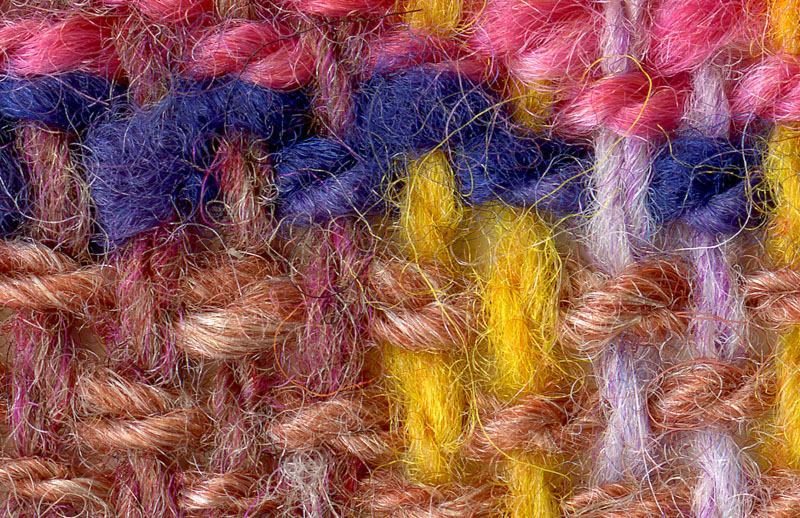
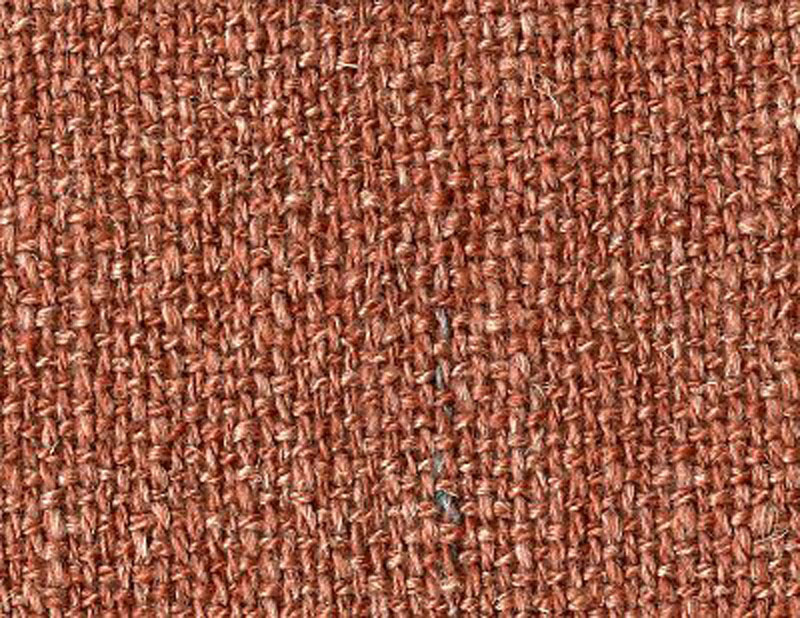
  • The following image is a scan of a fabric I wove on a rigid heddle loom a few weeks ago. It’s a balanced plain weave of 12 epi and ppi, hand washed and hung to dry. The yarn is a handspun wool/linen blend from my stash (I spun and plied the yarn from a custom batt I found at Lofty Fiber last year, an unlikely combination of natural flax and dyed wool). The scan is roughly life sized.

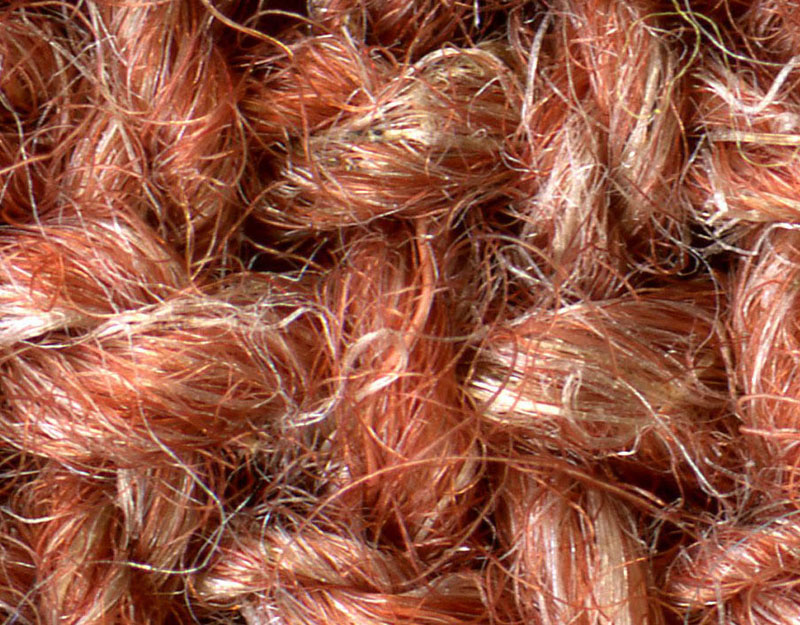
    And following is another scan of the same cloth, this time at about 32 times life size, executed on an old Epson scanner. In this scan the linen fibers really stand out.

    This was a fun project. First of all, the spinning was very easy. And second, I do love to play with my scanner! I feel like a kid with a new microscope.

  • I collected as many pincushions as I could find for an impromptu group portrait. The felt ones were purchased on Etsy, the handwoven ones are scraps of my own fabrics, and the one nestled permanently in its own ply-split basket (my one foray into ply-splitting) is my own creation. Why so many pincushions? Well, I try to keep one at each loom for the repair of broken warp ends, and of course one at my sewing machine, And one shows up next to my favorite chair when I am doing an evening of mending or hemming. They are like a little family, each with its own history, and I thought it would be fun to gather them together in this season of Thanksgiving.

  • Further explorations of network drafting with initials greater tnan straight 4-end. In this first example, for 8 shafts, I have used a point twill as the initial: 1-2-3-4-3-2.The resulting threading is tromped as writ, and the tieup has no floats longer than 2. Maximum float length in the resulting draft is 5.

    The same process is followed in the following draft for 16 shafts. Max float lenth in the tieup is 3, and max float length in the full draft is 5.

    I haven’t yet woven these drafts but I suspect the combination of plain weave and areas of longer floats will produce a lacy fabric suitable for table linens, curtains, etc.

    The software I’m using for these explorations is TempoWeave from LoftyFiber.

  • I spend hours playing with point twill threadings, mostly because I find them easy to thread on an 8 shaft loom. In the following illustration I show three stages in one of my experiments. Read these diagrams from right to left. First is a point twill threading with a treadling developed on a point twill initial (1,2,3,4,3,2). The max float length is 5. Then I took a small section of this treadling and mirrored it, so that the design contained internal symmetry. Max float went down to 3. In the final (leftmost) design, I turned the draft so that the treadling became the threading, then tromped as writ. The result is a lacy-looking thing.

    Here it is a little bigger. If you’d like to try weaving this, I’ve uploaded the draft to Handweaving.net as #81193.

    It’s a lot of fun to take sections of this draft and repeat or reduce them; and you can spend hours playing with changing or wrapping the tieup. Just remember to keep track of float length: longer floats require closer setts.

  • In this halvdrall draft, you will see that this design can be woven on 4 shafts. But because of the imbalance between numbers of heddles on shafts 1 and 2 compared to shafts 3 and 4, I would have had to move heddles around on the loom, a task I really hate and try to avoid. I have the luxury of 8 shafts on this loom, so I spread the threading out onto all 8 shafts. Problem solved.

    The warp is linen, the tabby picks are cotton, and the pattern wefts are marled linen and a very stiff natural colored hemp. All the yarns are from my stash, and I was going for maximum absorency. The following picture is the first towel cut off and hemmed, but not washed.

    The following picture is the towel after machine washing and drying. Shrinkage in warp & weft is about 12%. The absorbency is wonderful. However, I am very disappointed in the behavior of the hemp pattern weft which appears to have gone its own way and pokes out of both selvedges in a very uncivilized manner!

    Never mind. The towel will be used and enjoyed. Just not for company.